[填空题]
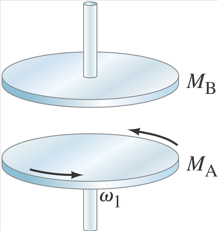
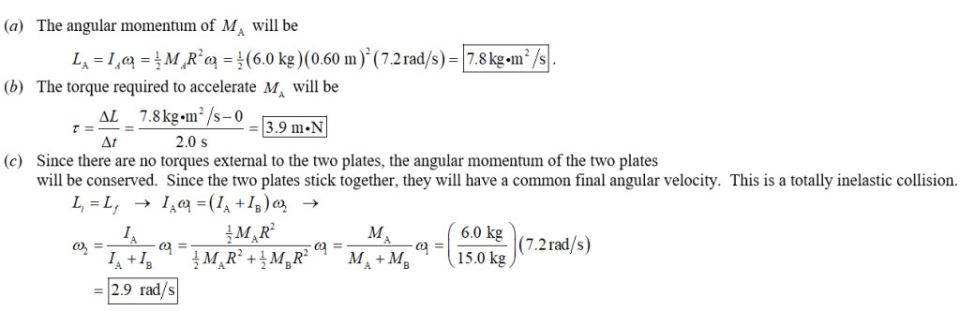
You are designing a clu7w7tq 2 bx7sur 4qkt7ktch assembly which consists of two cyliwr lsfdp3s9 o/fvx /9v2lz. .j :+k+cq fa/ilmndrical plates, of mass :clx.i s/ f9om+al/ j.+f2 r9s wv/kqvzflp3d$M_{\mathrm{A}}=6.0$ $\mathrm{kg}$ and $M_{\mathrm{B}}=9.0$ $\mathrm{kg}$ with equal radii R=0.60 $\mathrm{m}$ They are initially separated (Fig. 8–57). Plate $M_{\mathrm{A}}$ is accelerated from rest to an angular velocity $\omega_1=7.2$ $\mathrm{rad/s}$ in time $\Delta t=2.0$ s Calculate (a) the angular momentum of $M_{\mathrm{A}}$ $kg \cdot m^2$ (b) the torque required to have accelerated $M_{\mathrm{A}}$ from rest to $\omega_{1}$ $m \cdot N$ (c) Plate $M_{\mathrm{B}}$ initially at rest but free to rotate without friction, is allowed to fall vertically (or pushed by a spring), so it is in firm contact with plate $M_{\mathrm{A}}$ (their contact surfaces are high-friction). Before contact, $M_{\mathrm{A}}$ was rotating at constant $\omega_{1}$ After contact, at what constant angular velocity $\omega_{s}$ do the two plates rotate? $rad/s$



 Post time 2025-2-18 20:00:22